What Makes a Georgia State University Diploma Worth Exploring?
A Georgia State University diploma represents more than the completion of a degree. It connects students with a large public research university in the heart of Atlanta, where academic study often sits close to business, government, culture and professional life.
For many students, that combination is one of the most attractive features of Georgia State University.
Rather than separating college from the outside world, GSU places students in an urban environment where classroom learning, internships, research, networking and career planning can overlap.
Georgia State University at a Glance
Georgia State University, often called GSU, is a public research university in Atlanta, Georgia. The university was founded in 1913 and has grown into one of the largest and most diverse universities in the United States.
Today, Georgia State serves more than 53,000 students from across the United States and around the world. The university operates across multiple locations in the Atlanta metropolitan area and offers educational pathways from associate degrees through doctoral study.
You can also read more about the university’s history on Wikipedia.
Why Atlanta Matters to GSU Students
Location plays an important role in the Georgia State experience.
The main Atlanta campus sits in the center of the city, close to businesses, government offices, courts, nonprofit organizations, cultural institutions and professional services.
That location can give students access to internships, part-time work, networking events and professional experiences without leaving the city.
For students in fields such as business, law, public policy, media, health, technology and the social sciences, an urban campus can become part of the learning environment itself.
This is one reason a Georgia State University degree can appeal to students who want academic study and career exposure at the same time.
More Than One Way to Earn a GSU Degree
Georgia State offers a wide range of academic paths.
Students can pursue associate, bachelor’s, master’s and doctoral degrees across many different subjects. The university provides more than 250 degree programs in over 100 fields of study at the Atlanta campus, together with additional pathways through Perimeter College.
Academic areas include:
- business;
- arts and sciences;
- education;
- public policy;
- law;
- nursing and health professions;
- biomedical sciences;
- communication and the arts;
- computer science and technology;
- social sciences.
This variety means that two Georgia State University diplomas may represent very different academic experiences.
A business graduate, for example, follows a different path from someone studying nursing, law or data science.
A University Known for Student Success
One of Georgia State’s strongest national reputations comes from student success.
The university has invested heavily in advising, data analysis, student support and systems designed to identify academic problems before they become serious.
Georgia State reports that its six-year graduation rate has increased by 23 percentage points since 2003. It also says that these initiatives have reduced the average time students need to complete a degree.
This approach has made GSU a frequently discussed example of how large public universities can improve graduation outcomes.
That matters because the value of a university is not only about admission. Helping students actually complete their degrees is equally important.
Undergraduate Teaching at Georgia State
Teaching quality is another area where Georgia State has received national recognition.
According to the university, U.S. News & World Report ranked Georgia State No. 1 among public universities for undergraduate teaching in its 2026 rankings. GSU has also remained among the country’s most innovative public institutions for several consecutive years.
These rankings can change from year to year, but they reflect the university’s emphasis on teaching, academic innovation and student support.
For prospective students, the more useful question is how those priorities appear in everyday university life.
Smaller learning communities, academic advising, undergraduate research, experiential learning and career preparation can all influence the experience behind the final diploma.
Learning Beyond the Classroom
Georgia State emphasizes experiential education as part of its academic mission.
Students can take part in undergraduate research, internships, professional projects and other high-impact learning activities. The university also supports undergraduate research through dedicated academic programs and initiatives.
This type of learning can help students connect academic knowledge with practical skills.
For example, a student may learn finance in class while completing an internship with an Atlanta company. Another may study public policy while working with a government or nonprofit organization.
These experiences often become important when graduates begin applying for jobs.
What Does a Georgia State University Diploma Represent?
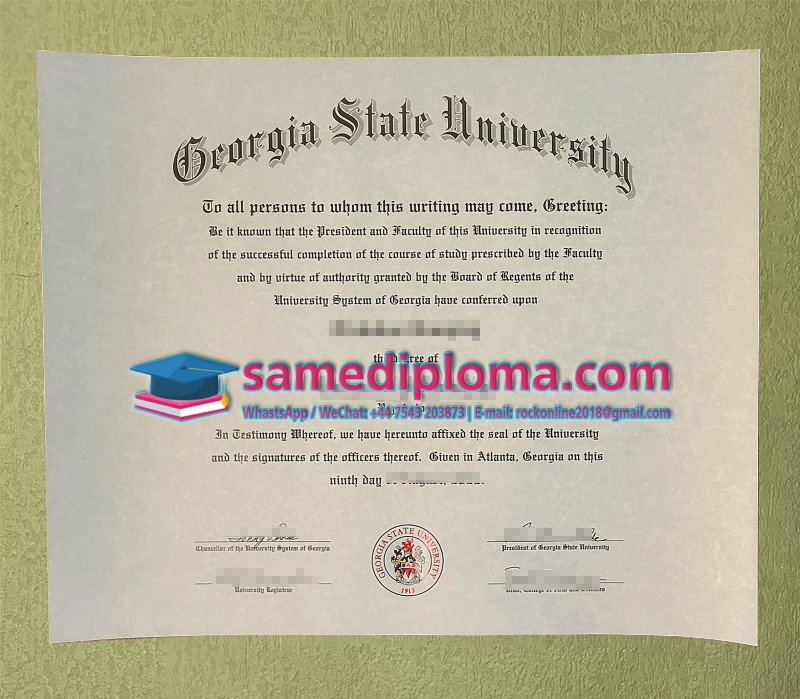
A diploma itself is only the final document.
The more meaningful information lies behind it:
Degree level
Was the student completing an associate, bachelor’s, master’s or doctoral program?
Major or field of study
The academic discipline helps explain the skills and knowledge developed.
College or school
GSU includes different colleges, schools and institutes with distinct academic focuses.
Graduation period
Programs, leadership, signatures and administrative details can change over time.
Academic experience
Research, internships, professional projects and campus involvement may add important value beyond coursework.
When evaluating a Georgia State University qualification, these factors provide more context than the physical diploma alone.
Diversity as Part of the GSU Experience
Georgia State also stands out for the diversity of its student population.
The university currently reports students from 155 countries and 49 U.S. states.
That creates a campus where students can work and study with people from different cultural, economic and academic backgrounds.
In a global job market, this kind of environment can help students develop communication skills and become more comfortable working with people who have different perspectives.
Is Georgia State University a Good Choice?
That depends on what a student wants from university.
GSU may be especially attractive to students who value:
- an urban campus;
- broad degree options;
- access to Atlanta employers;
- internships and professional experience;
- a diverse student community;
- strong academic support;
- research and experiential learning opportunities.
Other students may prefer a smaller residential campus or a different academic environment.
The best choice depends on the program, cost, career goals and preferred learning style.
The Value Behind a Georgia State University Diploma
A Georgia State University diploma gains its meaning from the education and experiences behind it.
The university combines a large public research environment with the opportunities of downtown Atlanta. Its focus on student success, undergraduate teaching, academic diversity and experiential learning gives students several ways to build skills before graduation.
For anyone researching GSU, the most useful approach is not simply to ask what the diploma looks like. Look at the degree, academic program, career opportunities, learning environment and experiences that lead to it.
Those factors explain much more about the real value of a Georgia State University education.