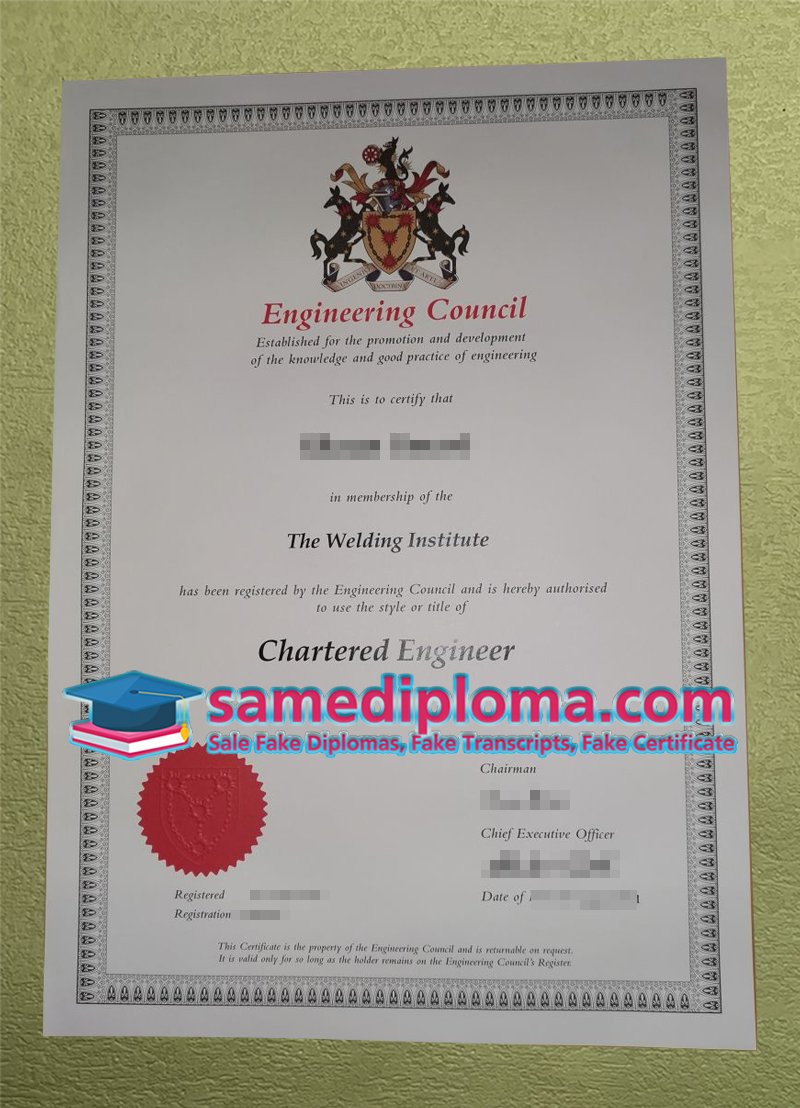
An engineer preparing a document folder may discover that one certificate is missing. Searching for “diploma engineering council” seems a reasonable next step, particularly when the exact title is hard to remember. Yet requests for a duplicate certificate in the UK depend on what the original document represents. An Engineering Council registration certificate records professional status. It is different from a university diploma, an academic transcript or a privately designed achievement print. Where to Buy a Fake Engineering Council Chartered Engineer Certificate
That distinction changes the enquiry. If you already hold an active registration, you may need another copy of the certificate. If you want to become registered, you need guidance on assessment. If your purpose is simply to mark a career milestone, a clearly identified commemorative design may answer a separate personal need. None of these tasks begins with choosing which professional letters would look best on paper.
The Engineering Council dates from 1981, when it received its Royal Charter following the debate surrounding the Finniston inquiry. Its history helps explain why its name appears alongside professional institutions rather than only universities. The organisation maintains professional registration standards, while licensed professional engineering institutions assess applicants. An engineering degree can contribute to a person’s preparation, but a degree certificate and a registration certificate document different achievements.
The professional titles include Chartered Engineer, or CEng; Incorporated Engineer, or IEng; Engineering Technician, or EngTech; and Information and Communications Technology Technician, or ICTTech. These are not interchangeable labels for one document. Someone seeking a copy should use the title attached to their actual registration. Changing the wording on a printout cannot change the category in which a person has qualified.
For CEng, the emphasis lies on demonstrated professional competence and commitment. The standards address technical understanding, engineering problem-solving, responsibility, communication and professional conduct. They extend beyond remembering material from a university course. A person’s ability to explain decisions, recognise limitations and take responsibility for work matters alongside technical knowledge. The Engineering Council’s UK-SPEC guidance provides the framework for understanding these requirements.
This is also why “CEng means having a master’s degree” is an incomplete explanation. The Council describes recognised educational pathways, including appropriate accredited study, but applicants may demonstrate the required learning through other routes. An applicant should discuss their qualifications and experience with a relevant licensed institution. Neither possession of a particular degree nor the purchase of a certificate removes the need to demonstrate the professional standard.
For someone considering registration, a useful starting exercise is to describe their work plainly. Which decisions do they make? What technical responsibility do they carry? How do they explain risks and resolve problems? These questions are preparation prompts, not a substitute for the institution’s application guidance. They help an engineer identify the evidence they already have and the areas where further development may be necessary.
The question “Is Chartered Engineer status worth it?” therefore depends partly on the person’s work and goals. Look at requirements in relevant roles, discuss progression with an employer, and ask the professional institution how registration relates to your practice. Recognition can be useful without guaranteeing a promotion or a particular salary. A stronger decision comes from connecting the requirements to actual responsibilities rather than treating the certificate as a shortcut.
For an existing registrant, the problem may be much simpler: the original certificate was lost during a move, damaged in storage or left in an old office. The Engineering Council provides an official route for replacement and additional registration certificates. Its current order form limits this service to people with active registration. If you are unsure whether your registration remains active, clarify that before placing a certificate order.
The official certificate ordering information currently lists a price of £20, including delivery and VAT. Orders are processed weekly. That processing schedule is not a promise that a certificate will reach every destination within seven days. Check the current instructions and allow for the delivery stage, especially when another organisation has imposed a deadline.
Another detail matters for people replacing a much older document. The Council says replacement and additional certificates use the current design, introduced on October 1, 2014. An official replacement may therefore look different from the original certificate you remember. That difference does not, by itself, make the replacement inappropriate. Its purpose is to document registration through the authorised service, not to recreate every visual feature of an earlier edition.
Suppose you want to preserve the appearance of your original certificate for a family archive. Keep any surviving photograph or scan as a historical image. Store it separately from the new official document and label both clearly. You can retain the memory of an older design without asking a private supplier to imitate an official registration record.
Before making an enquiry, gather the information needed to identify your registration. Keep your name, registration details and relevant professional institution information together. Follow the current form rather than a checklist copied from an old sales page. If something in your records has changed, explain the discrepancy through the official contact route. Guessing an old membership number or silently changing a name may make the enquiry harder to resolve.
Consider the recipient’s needs as well. An employer asking whether you currently hold CEng status may need confirmation of registration rather than another framed certificate. An academic admissions team may instead want your university transcript. Ask what evidence it accepts and whether it requires direct confirmation. This can prevent an unnecessary purchase and reduce the chance of sending an impressive-looking document that answers the wrong question.
The Engineering Council’s professional registration FAQs distinguish confirmation of registered status from certifying a copy of a certificate. The Council says it can provide status confirmation by letter or email, but does not certify the certificate itself. If someone asks for a “certified copy,” obtain their exact requirements before arranging anything. Different requests can sound similar while requiring different evidence.
Paper and digital formats introduce another common source of confusion. A photograph of a genuine certificate is a photograph; converting it to PDF does not automatically create an independently verifiable digital credential. Likewise, a high-resolution design file does not establish professional standing. Ask how the receiving organisation checks information instead of assuming that file quality determines acceptability.
For personal storage, keep a readable scan and preserve the original file. Use a filename that distinguishes the professional registration certificate from a degree certificate or membership document. An archive with clear labels is easier to manage than several files all called “engineering diploma.” Keep sensitive details out of public galleries, and avoid uploading identification documents to services that do not need them.
There is also room for a separate, clearly nonofficial celebration of a career. A retirement print, a project anniversary illustration or a personal engineering achievement poster can carry meaning without resembling a registration certificate. It might feature an authorised project photograph, a personal dedication or a short account of a contribution. Its wording should describe real achievements and make the commemorative purpose obvious.
If you commission such artwork, decide whether you need only a digital file or a printed item. Confirm the dimensions, the number of revisions and the intended use before comparing prices. For a print, ask whether packaging and delivery form part of the quote. For a digital design, confirm the file format and whether it suits your intended printer. These are ordinary design decisions, separate from professional assessment.
A clear brief protects that distinction. For example, “Create a nonofficial retirement print celebrating twenty years in engineering” describes a personal project. Asking for a document that suggests an unearned CEng registration describes something entirely different. The designer should not reproduce official signatures, verification features or claims of registration that the recipient does not hold.
Whatever route you choose, retain the correspondence and the final document together. Note whether the item is an official replacement, a personal scan or commemorative artwork. If you later send it to someone else, explain its purpose accurately. Good recordkeeping begins with clear descriptions, not with trying to make every document look identical.
The most useful answer to “Can I make a copy of an Engineering Council diploma?” starts by naming the document correctly. For active professional registration, use the official certificate service when you need a replacement or additional copy. For a career application, establish which evidence the recipient requires. For a personal keepsake, choose an openly nonofficial design. The right choice follows from the task, rather than from how closely a printed page resembles a credential.