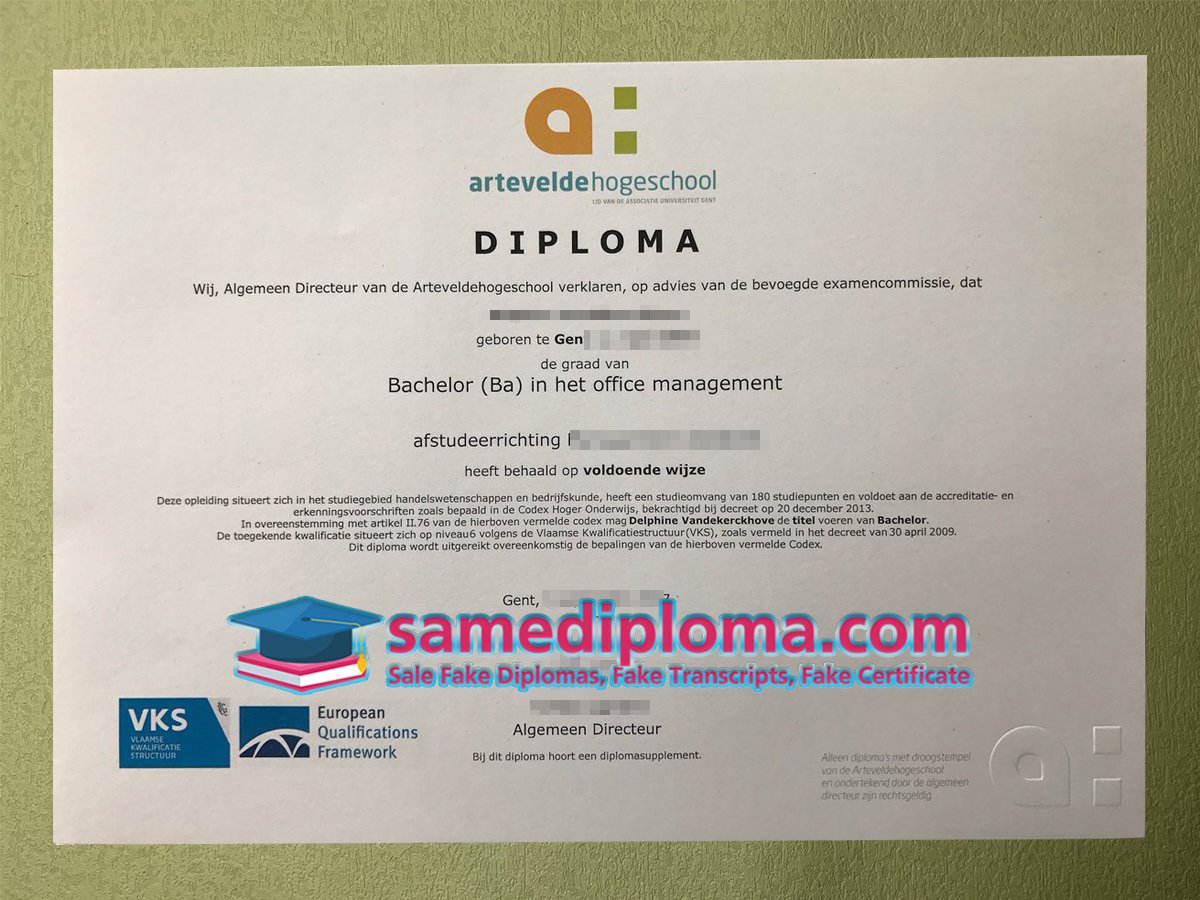
How can I get a diploma if I haven’t completed the artevelde hogeschool? Two Artevelde Hogeschool diploma samples can look different without one simply being a newer version of the other. Within Belgian higher education, the qualification behind a document deserves attention before its appearance. The two samples described here raise that question: one carries a bachelor-related label, while the other refers to a Graduaat. Their layouts differ, but the reason for that difference remains open.
The accompanying observations also describe two embossed marks. One appears to contain a logo symbol alone; the other includes lettering. This is a useful detail to record. However, it does not establish a redesign date, an official production sequence or the authenticity of either document. Without confirmed dates and institutional context, “different” is the most accurate description.
That distinction gives this comparison its value. A sample page can explain what someone has noticed without turning a possible explanation into a definite claim. It also helps readers avoid confusing a change in qualification with a change in graphic design.
Arteveldehogeschool is the institution’s Dutch name. The spacing “Artevelde Hogeschool” often appears in searches, but an enquiry about a personal record should follow the institution’s own wording. More importantly, include the full programme and award title. A search phrase describes what someone wants to find; it does not necessarily reproduce the wording of their qualification.
For current Flemish qualifications, a Graduaat corresponds to level 5 of the Flemish Qualifications Structure, while a bachelor corresponds to level 6. The Flemish government explains these levels in its guidance on higher-education diplomas and credit certificates. These are separate qualifications, so their documents need not communicate identical information.
The shorthand “BA” needs care too. In this comparison, it identifies the sample that the owner describes as a bachelor document. It does not confirm the exact award title. Read the full wording before expanding an abbreviation to “Bachelor of Arts” or assigning it to a particular subject.
Two situations illustrate why this distinction matters. Someone may finish a Graduaat and then begin a bachelor’s programme. Their completed qualification and their new studies are separate entries in their history. Another person may attend a bachelor’s programme without completing the award. That attendance does not by itself establish that they earned a Graduaat. These hypothetical examples show why a document label cannot replace the actual record.
In a description of your own education, distinguish what you completed from what you started. Use the exact award for the completed programme. For unfinished studies, state the course and period of attendance without adding an award you did not receive. This preserves the value of completed work while giving the reader an accurate account.
That matters when someone asks whether two certificates represent the same achievement. Similar paper, institutional branding or page proportions cannot answer that question. Equally, a different arrangement of text does not by itself prove a different academic level. The written qualification and the institution’s record provide the relevant context.
There is also a time dimension, although it requires restraint. A school may change its presentation over time, and different award types may use different layouts. Either possibility could explain part of what someone notices. Neither explanation follows automatically from two images with incomplete histories.
An older qualification may also use terminology from an earlier educational structure. Therefore, treat the current level comparison as a description of current qualifications. For a historical document, ask the institution how its exact award title relates to today’s terminology. Do not apply a modern label solely because one word looks familiar.
The layout difference itself can still support a useful design discussion. Look at the broad reading experience: which information attracts attention first, how the page groups the award wording, and whether the text feels dense or spacious. Those observations concern communication. They do not require a verdict about which sample is newer or more authoritative.
For example, two documents can create different impressions simply because their text takes up different amounts of space. A longer programme title may alter the balance of a page. This is a general design possibility, not a confirmed explanation for these particular samples.
Similarly, the observation about an icon-only mark and a mark with lettering should remain limited to the examples described. It does not justify a rule that every bachelor document uses one mark and every Graduaat uses the other. A useful article leaves room for that uncertainty instead of presenting an unsupported version chart.
For a graduate, the diploma supplement can help move the discussion beyond appearance. Under the Flemish guidance linked above, the diploma and supplement belong together. The supplement explains the qualification’s nature, level and programme content. It can therefore answer questions that a photograph of the award page leaves unresolved.
Keep that supporting document with your diploma when organising a personal archive. If someone asks what you studied, start with the academic information. A close-up of an embossed mark may be visually interesting, but it cannot explain the content of a programme or replace a record of results.
Language can create another source of confusion. A Dutch-language document from a Belgian institution is not evidence that the institution operates in the Netherlands. When describing an Arteveldehogeschool diploma, keep the institution, country and document language separate. This makes an enquiry clearer for a reader unfamiliar with Flemish higher education.
If you need an official document, Arteveldehogeschool directs diploma enquiries to its student administration service. Its published contact page includes a diploma duplicate request route and requests for an English diploma or diploma supplement. Follow the school’s current instructions for your situation rather than choosing a document from an image search.
Explain what has happened and what you need. You might have lost a certificate, need information in English, or want clarification about an older award. These are different enquiries. Giving the office a specific question helps it identify the relevant record and explain the available options.
Before making a request for an application, check the recipient’s requirements as well. Ask whether it needs the award document, the supplement, a transcript or confirmation directly from the institution. A request for “proof of education” can otherwise leave both sides guessing about the expected evidence.
Incomplete study involves a different question. Passing part of a programme can lead to credit certificates for successful components. Receiving the full diploma depends on the institution’s decision that the programme requirements have been met. If you paused or left your studies, ask what completed learning your record shows and what steps remain available.
A failed assessment, leave of absence and withdrawal do not describe the same situation. Explain your circumstances accurately to student administration or your programme adviser. Ask about your existing results and any possible return to study. A privately produced certificate cannot complete the missing academic requirements or create an award.
For personal recordkeeping, distinguish an issued digital document from a photograph or scan. A scan can help you find information quickly, but it does not automatically have the same status as an institution-issued electronic record. Keep the original file intact and check what format the intended recipient accepts.
If you prepare an image for public discussion, protect the owner’s personal details. Keep an untouched private copy and make a separate version for sharing. A descriptive caption can explain that the image serves as an example, with personal information obscured. Avoid presenting it as a universal template for every graduate.
A commemorative design offers a separate creative route. Someone might want a personal print about their time in Ghent or a digital image for a graduation gathering. That project can use an original composition, a personal photograph and an honest message. It does not need to reproduce the diploma’s embossed features or official certification language.
Keep the finished artwork visibly identifiable as a personal keepsake. If it refers to an earned qualification, use accurate wording. If the purpose is simply to celebrate a period of study, describe that experience without inventing a completed award. A personal story can remain meaningful without resembling an institutional document.
The question raised by these two Arteveldehogeschool samples remains worth discussing: how much of a document’s appearance reflects its qualification, and how much reflects its period? At present, the observations establish a difference, not its cause. The full award title and an answer from the institution will tell the owner more than a guess based on the logo.