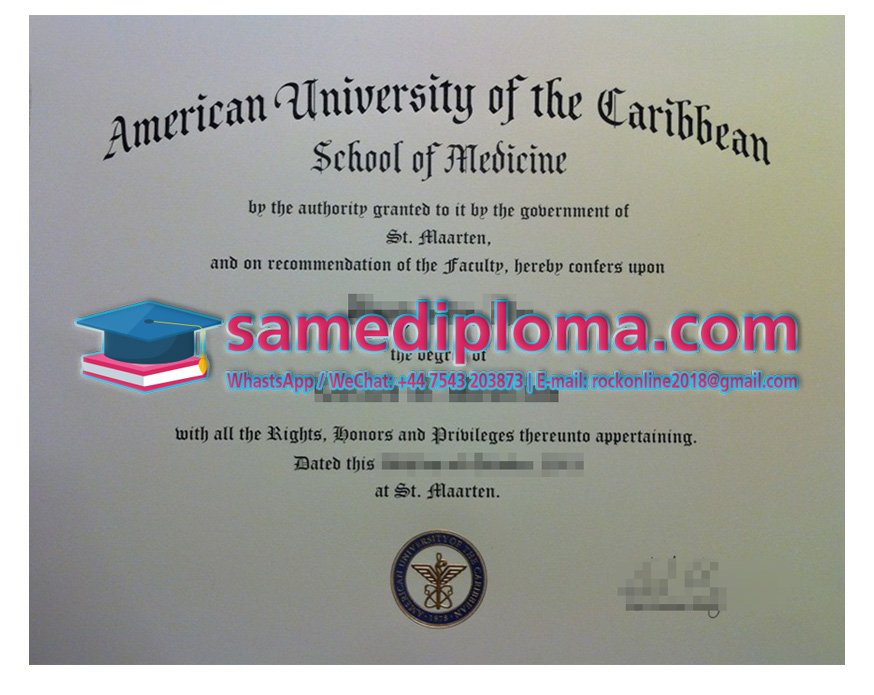
Understanding the American University of the Caribbean Diploma
The American University of the Caribbean Diploma is associated with a medical education program rather than a traditional multi-subject university.
American University of the Caribbean School of Medicine is commonly known as AUC. It provides a Doctor of Medicine program designed for students who plan to enter the medical profession.
The program combines medical science, clinical learning, simulation, and patient-based training. Students progress from foundational medical subjects into supervised clinical experience. AUC School of Medicine
For anyone researching an AUC diploma or degree, it helps to understand how this medical education pathway works.
What Is American University of the Caribbean School of Medicine?
AUC is an international medical school with its main campus in Sint Maarten.
Its academic focus is medicine. Unlike a general university, AUC does not center its curriculum around dozens of unrelated undergraduate majors.
Instead, the school provides a structured Doctor of Medicine program.
Students study core medical sciences before moving into clinical training. This structure follows a model designed to prepare students for medical examinations and residency training.
The school also offers a U.K. track for eligible non-U.S. students. That option begins in Preston, England.
What Does an American University of the Caribbean Diploma Represent?
An American University of the Caribbean Diploma generally relates to successful completion of the school’s medical degree requirements.
The main qualification is the Doctor of Medicine, or MD degree.
Students must complete both academic and clinical components before reaching graduation.
This makes the diploma the final academic document connected with a much longer medical training process.
It should not be confused with a transcript.
A diploma confirms the degree awarded. A transcript provides more detailed academic information.
The AUC Doctor of Medicine Program
AUC describes its program as a U.S.-modeled Doctor of Medicine curriculum.
The program combines traditional medical sciences with clinical education and modern teaching methods.
Students may encounter:
- Medical science courses
- Case-based learning
- Clinical skills training
- Simulation exercises
- Small-group learning
- Patient interaction
- Clinical rotations
- Elective medical training
The curriculum is designed to connect scientific knowledge with real clinical decision-making.
This helps students move gradually from classroom-based study into direct medical practice.
Years One and Two: Medical Sciences
The first stage focuses strongly on medical science.
Students build knowledge in areas that support later clinical work.
The curriculum uses an integrated, organ-system approach. Scientific concepts are connected with clinical examples and medical reasoning.
Students also develop clinical skills from an early stage.
This is important because medical education involves more than memorizing scientific facts.
Future doctors must learn how to interpret symptoms, communicate with patients, and make informed clinical decisions.
AUC also prepares students for the USMLE Step 1 examination during this part of the program.
Years Three and Four: Clinical Training
Clinical education becomes the main focus during the later stages of the program.
AUC currently states that students complete 80 weeks of clinical training.
These rotations may take place at affiliated clinical sites in the United States or the United Kingdom.
During rotations, students gain experience in real healthcare environments.
They may work in areas such as internal medicine, surgery, pediatrics, psychiatry, obstetrics and other specialties.
This part of the program allows students to apply classroom knowledge to patient care.
It also helps them explore possible medical specialties.
Why Clinical Rotations Matter
Clinical rotations are an essential part of medical education.
Students must learn how illness presents in real patients.
They also need experience working with physicians, nurses, and other healthcare professionals.
Clinical training develops several important abilities.
These include communication, diagnosis, teamwork, medical documentation, and professional judgment.
By the time students complete their rotations, they have experienced different areas of medicine.
This can help them make more informed decisions when applying for residency programs.
AUC Accreditation
Accreditation is especially important when researching an international medical school.
American University of the Caribbean School of Medicine is accredited by the Accreditation Commission on Colleges of Medicine (ACCM). ACCM is the medical school accreditor used by Sint Maarten.
The U.S. Department of Education’s National Committee on Foreign Medical Education and Accreditation has reviewed ACCM’s standards.
According to AUC, those standards have been determined to be comparable with standards used for medical education accreditation in the United States.
AUC also states that its continued ACCM accreditation currently runs through 2027.
Accreditation matters because medical graduates often need to meet specific requirements before entering residency or seeking professional licensure.
USMLE and Medical Licensing
Medical school graduation is only one stage in becoming a practicing physician.
Students who plan to enter medical training in the United States must also complete required licensing examinations and residency training.
AUC students may register for the United States Medical Licensing Examination, subject to applicable eligibility requirements.
The school states that its students can pursue ECFMG certification and that graduates can seek medical licensure across U.S. states after meeting the required licensing conditions.
An American University of the Caribbean Diploma confirms an academic medical degree. It does not automatically create an unrestricted license to practice medicine.
Studying in Sint Maarten
AUC’s Sint Maarten location gives the medical program an international character.
U.S. citizens normally complete the first two years of the MD program there.
Eligible non-U.S. students may also study at the U.K. track in Preston.
Students then move into clinical training at affiliated hospitals and medical sites.
This creates a study experience that may involve several countries and healthcare systems.
For some students, that international exposure can be an important part of their medical education.
What Documents May Graduates Receive?
A medical graduate may receive several academic records.
The exact documents can depend on university procedures and the graduate’s program.
Common academic documents may include:
- Degree diploma
- Academic transcript
- Graduation records
- Clinical records
- Supporting academic documentation
These documents serve different purposes.
The American University of the Caribbean Diploma confirms the degree itself.
The transcript provides details about academic progress and completed coursework.
For employment, licensing, or postgraduate training, organizations may request more than the diploma alone.
American University of the Caribbean Diploma vs Transcript
The difference is straightforward.
A diploma confirms that the university awarded a degree.
A transcript records the student’s academic history.
It may contain courses, grades, credits, and other academic information.
Medical graduates may need official transcripts during residency applications or professional credential reviews.
For this reason, the diploma and transcript should not be treated as interchangeable documents.
Preparing for Residency
After medical school, many graduates continue into residency.
Residency provides supervised postgraduate medical training in a selected specialty.
AUC reports that its graduates enter residency programs in the United States and other countries.
The university currently reports a three-year first-time residency attainment rate above 97%.
That figure covers the 2023–24 through 2025–26 academic years and uses AUC’s stated methodology.
Residency outcomes can change over time, so current applicants should always check the latest official statistics.
Final Thoughts
The American University of the Caribbean Diploma is connected with AUC’s Doctor of Medicine program.
The degree pathway combines medical sciences, clinical education, examinations, and practical training.
Students begin with foundational medical study and later move into supervised clinical rotations.
AUC is accredited by ACCM and offers an international route into medical education.
For anyone researching an AUC academic document, the most important details are the MD degree, graduation date, transcript, and clinical education record.
These details provide much more useful context than the diploma title alone.