University of Roehampton Transcript: Paper Copies, Digital Files and the Surrey Connection
An older University of Roehampton transcript can raise a question before you even read the results: why does Surrey appear in the paperwork? Our related Buy a University of Surrey degree provides another point of reference when exploring these connected university names. For a paper copy or electronic design project, start with the document you actually hold. Its date, wording and purpose matter more than choosing the newest-looking layout.
We offer electronic design and paper printing for clearly labelled non-official projects, alongside authorised document digitisation. These services can support personal archives, educational illustrations or fictional props. However, an official academic transcript must come through the appropriate university records service. Deciding which type you need makes every later choice easier.
Why Roehampton and Surrey Appear in the Same History
Roehampton’s history reaches beyond its independent university status. In 1975, Southlands, Digby Stuart, Whitelands and the Froebel Institute came together to form the Roehampton Institute. Their earlier identities help explain the college names that alumni still associate with their studies.
The relationship with Surrey forms a distinct chapter. In 2000, the institute became the University of Surrey Roehampton within the Federal University of Surrey. Then, on 1 August 2004, Roehampton gained independence as Roehampton University.
The University of Roehampton records this transition in its Southlands College history. Consequently, Surrey’s appearance in older Roehampton-related material can reflect a genuine institutional connection.
For a historical project, keep the original naming in context. Do not automatically replace an earlier institutional name with today’s wording. Equally, the history alone cannot establish which heading, format or issuing authority belongs on an individual document. Check the source itself.
A Transcript Records More Than a Graduation Milestone
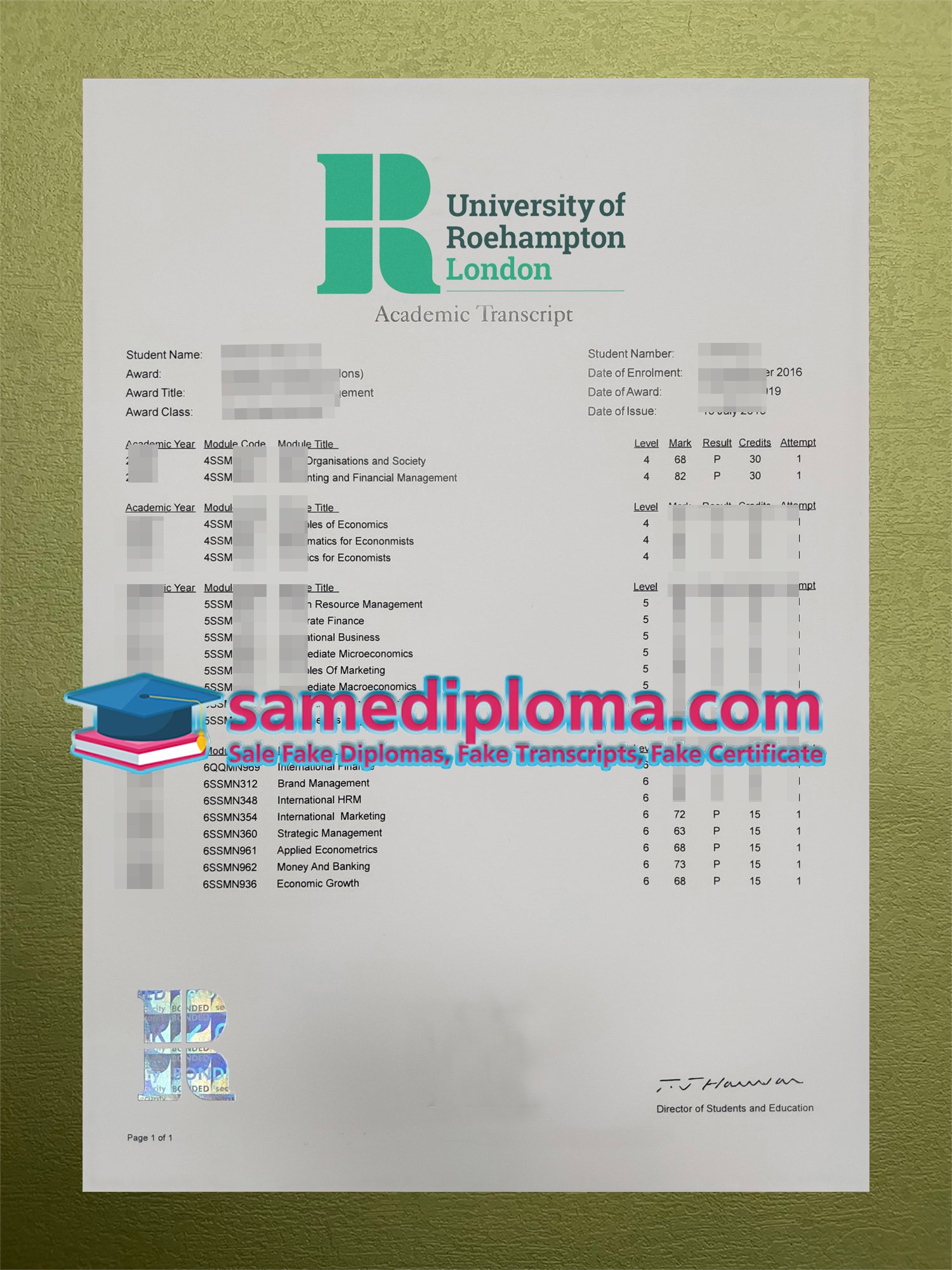
A degree certificate and a transcript serve different purposes. The certificate confirms an award, while the transcript provides a record of academic study and results. Depending on the document, that record may include modules, marks, credits and explanatory notes.
Therefore, a transcript project needs more than an attractive first page. A missing continuation page or grading explanation can leave the reader with an incomplete record. Before preparing an authorised scan, count the pages and check their order.
For example, a personal archive might contain a certificate, several result sheets and a later letter from the university. Keep these items separate and identify each one accurately. Combining them into a newly invented transcript would change the nature of the source material.
When an employer or admissions office requests academic evidence, ask what document and delivery method they accept. A privately printed copy does not become university-issued evidence simply because it looks tidy.
Choosing an Electronic Version for Your Project
An electronic version can make a personal archive easier to organise. You can keep related pages together, find them by filename and review them without repeatedly handling older paper.
First, distinguish between digitising an existing document and commissioning a new design. With an authorised original, the task may involve scanning, straightening and careful cropping. The academic information should stay unchanged.
By contrast, a fictional transcript illustration starts with invented content and a visibly non-official presentation. A classroom demonstration or theatre prop should carry a clear sample label within the artwork. That label should remain visible in both the digital file and any printed version.
Also, agree on the final file type before work begins. A PDF can hold several pages together. An image file may suit a single illustration, but it does not automatically offer the same convenience for a longer record.
Tell us whether you need a screen preview, a finished digital file or a file for later printing. These are different deliverables, so the brief should name each one you expect.
Planning a Paper Version That Is Easy to Read
Paper introduces choices that a screen preview cannot settle. Small text may look clear when enlarged on a monitor, yet become difficult to read at the intended print size. For that reason, review a test print before approving multiple copies.
Start with legibility. Check the smallest notes, the spacing between rows and the page margins. A busy background or overly decorative typeface can compete with the information.
Next, confirm how the pages will work together. A single-sided set may suit one personal archive, while another project may require a different arrangement. Follow the source for an authorised reproduction, rather than assuming that every document uses both sides.
For fictional props, ordinary presentation choices should support the scene without suggesting official authentication. Clear sample markings belong on every relevant page. Special paper or elaborate finishing cannot make a privately produced document an official transcript.
If you need both paper and electronic versions, approve one consistent final set. This helps prevent an outdated digital draft from accompanying the printed copy.
What Older Graduates Should Check Before Ordering Anything
The Surrey connection does not mean that Surrey handles every Roehampton record. Roehampton’s replacement certificates and transcripts guidance separates the two document types and uses different date categories.
For degree certificates, it directs students whose degrees commenced from 1984 to 2004 to Surrey. For transcripts, it lists Roehampton as the route for degrees awarded from 2001.
Earlier records need particular care. The guidance says that marks for awards between 1984 and 1991 are no longer available to produce transcripts. It also notes limited information for awards between 1992 and 2000 and asks graduates to contact Registry first.
Roehampton currently provides an email route for PDF transcript requests and an online ordering route for printed copies. Check its current instructions before applying.
These distinctions explain why graduation year alone may not answer every question. If records are incomplete, ask the university what it can confirm. A design service cannot reconstruct missing academic results as verified facts.
Preparing Material for Digital Editing
For an authorised archive project, provide a complete, readable source. Include page edges and any explanatory pages. If you photograph the document, avoid shadows across the text and keep the camera square to the page.
Keep an untouched master copy before editing. Then use a separate working file for cropping, rotation or modest contrast adjustments. This gives you a reference if an edit accidentally removes information.
Do not guess at an unclear mark, date or module code. Flag the uncertainty instead. Where accuracy matters, ask the issuing institution to clarify the entry.
Privacy also deserves attention. Student numbers, addresses and other personal details rarely need to appear in a public portfolio image. Use a separately redacted preview, and confirm permission before publishing it. Keep that preview distinct from your private archive.
Agreeing on Scope, Revisions and Delivery
A useful order brief answers four questions: what is the purpose, what source material exists, what outputs do you need, and when do you need them?
For instance, you might request an authorised scan for private storage plus a clearly marked personal reference print. Alternatively, you might need a fictional educational illustration in digital form only. Those projects require different decisions and should receive different descriptions.
Before approving a quote, confirm the page count, file formats, number of prints and revision scope. If you have a deadline, separate digital completion from printing and delivery. An electronic proof does not mean that a physical parcel is ready.
During review, check every page rather than only the cover. Confirm that labels remain visible, page order stays consistent and the agreed output matches the brief.
Start with the record’s purpose and historical context. Then choose the paper or digital service that fits it. For Roehampton-related material, that approach preserves the Surrey connection accurately while keeping official academic records and private design work clearly identifiable.