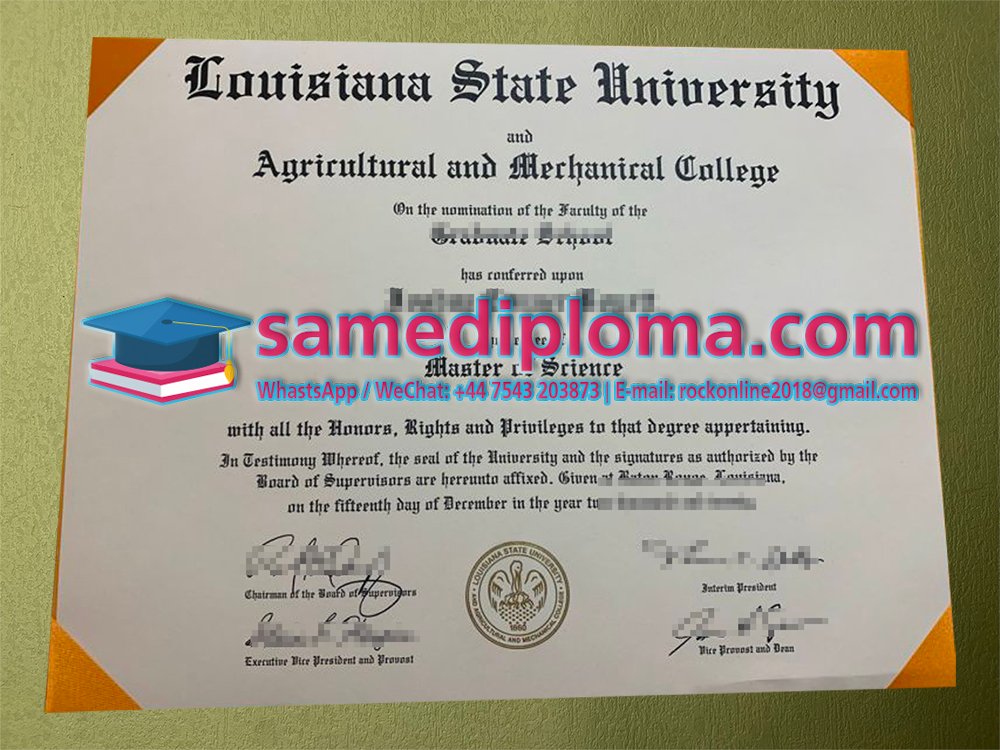
Louisiana State University Diploma and the LSU Experience
A Louisiana State University Diploma comes from a university with a very different character from a small private college or regional campus. LSU is Louisiana’s flagship public university, based in Baton Rouge, with roots reaching back to 1860. If you are comparing other U.S. university qualifications, you may also find the University of Georgia Diploma and Florida Gulf Coast University Diploma useful for understanding how American university programs can differ from one institution to another.
But LSU is easier to understand through its scale, location and traditions than through a simple list of facts.
Purple and gold are everywhere.
So are live oak trees, lakes, research buildings, athletics and the unmistakable atmosphere of a large Southern public university.
LSU Started Somewhere Very Different
The university did not begin in Baton Rouge.
Its original institution opened in 1860 near Pineville, Louisiana, under the name Louisiana State Seminary of Learning and Military Academy. William Tecumseh Sherman served as its first superintendent.
The early years were turbulent.
The school closed during the Civil War, reopened, and later lost its original campus to fire in 1869.
It then moved to Baton Rouge.
In 1870, the institution took the name Louisiana State University. It later merged with Louisiana Agricultural and Mechanical College in 1877.
That history gives LSU a very different background from universities founded as modern campuses in the twentieth century.
The Baton Rouge Campus Is Part of the LSU Identity
Today, LSU’s main campus sits in the southern part of Baton Rouge near the Mississippi River.
The campus covers more than 2,000 acres and is known for lakes, live oaks and Italian Renaissance-style architecture.
That setting matters.
For many students, LSU is not simply a place where they attend classes.
It is a campus where academics, sports, traditions and student life are closely mixed together.
That is probably why the phrase “Love Purple, Live Gold” feels more like a university identity than just a slogan.
A Louisiana State University Diploma Can Represent Many Fields
LSU is a large comprehensive university.
Its current academic offerings span more than 330 fields of study, covering areas such as business, engineering, agriculture, science, communication, art, law and environmental studies.
Students can enter fields including:
- Accounting
- Agricultural Business
- Architecture
- Artificial Intelligence
- Biological Sciences
- Business Analytics
- Civil Engineering
- Computer Science
- Finance
- Journalism
- Landscape Architecture
- Mechanical Engineering
- Petroleum Engineering
- Psychology
- Veterinary-related pathways
So a Louisiana State University Diploma can represent very different academic experiences.
An engineering graduate may spend years in laboratories and technical projects.
A mass communication student may work with journalism, advertising or political communication.
A coastal science student may study problems that are especially relevant to Louisiana itself.
Louisiana Shapes What LSU Teaches
This is one of the more interesting things about LSU.
Some universities could almost be moved to another state without changing much.
LSU is harder to separate from Louisiana.
The College of the Coast & Environment, for example, studies coastal and environmental issues in a state that contains a large share of America’s coastal wetlands.
Agriculture is another major area.
So are petroleum engineering, environmental science and coastal research.
That connection between place and subject gives the university a practical dimension that a simple degree list does not show.
Engineering Has a Strong Presence
Engineering is one of LSU’s major academic areas.
The College of Engineering includes programs such as:
- Chemical Engineering
- Civil Engineering
- Computer Engineering
- Computer Science
- Construction Management
- Electrical Engineering
- Environmental Engineering
- Industrial Engineering
- Mechanical Engineering
- Petroleum Engineering
These fields reflect both national industry needs and Louisiana’s own economic environment.
Oil, energy, infrastructure and coastal engineering have long been important in the region.
That gives students opportunities to connect technical study with real problems outside the classroom.
Business Is Another Major Path
The E. J. Ourso College of Business offers areas such as accounting, finance, management, marketing, entrepreneurship and business analytics.
Business at LSU is not isolated from the rest of the university.
Students can combine business interests with technology, international trade or data.
For someone looking at a Louisiana State University Diploma in business, the specific major often says far more than the university name alone.
A finance degree and a business analytics degree may come from the same college, but the skills behind them are very different.
Graduate Study Is Much Larger Than Many People Expect
LSU also has a substantial graduate education system.
The Graduate School currently reports more than 110 master’s programs and more than 85 doctoral programs.
Graduate study covers fields ranging from engineering and science to business, education, social sciences and creative disciplines.
Some programs are also available online.
That means the phrase Louisiana State University Diploma may refer to much more than an undergraduate bachelor’s degree.
It can also relate to master’s, doctoral or professional education.
Law and Veterinary Medicine Give LSU Another Dimension
LSU includes both the Paul M. Hebert Law Center and a School of Veterinary Medicine.
The Law Center has a particularly interesting feature: LSU describes its Juris Doctor and graduate diploma in comparative law combination as unique in the United States.
Veterinary education is another distinctive area.
Together, these professional schools make LSU more than a standard undergraduate university.
Students may spend years following highly specialized professional paths before reaching graduation.
The Diploma Is Only the Final Page
This is something worth remembering.
A diploma is the visible end of the process.
The real LSU experience happens before that.
For one student, it may mean engineering projects.
For another, field research along the Louisiana coast.
For someone else, it may involve business cases, journalism assignments, veterinary training or graduate research.
That is why looking only at the wording on a Louisiana State University Diploma does not tell the full story.
The academic field matters.
So does the college.
So does the level of study.
LSU Is Also a Research University
Research plays a major role at LSU.
The university is designated as a land-, sea- and space-grant institution, reflecting its broad research mission and public role.
This matters because large research universities operate differently from teaching-only institutions.
Faculty are not only teaching courses.
They are also conducting research, supervising graduate students and contributing to new work in their fields.
For students, that can create opportunities to participate in research before graduation.
Purple and Gold Are More Than Decoration
Some universities are remembered mainly for academics.
LSU also has a very strong campus culture.
Purple and gold, Mike the Tiger, athletics and long-standing traditions are highly visible parts of student life. LSU reports more than 166,000 alumni worldwide.
For many graduates, those traditions become part of the emotional value of the diploma.
Years later, the certificate may represent more than classes and grades.
It can also bring back memories of Baton Rouge, campus life, friends and university traditions.
Diploma, Degree and Transcript
These terms are often mixed together online.
They are related, but they are not identical.
A degree is the academic qualification earned.
A diploma is the physical document showing that the university awarded that degree.
A transcript provides a more detailed academic record, including courses and grades.
If someone needs to prove exactly what they studied, the transcript usually provides more information than the diploma itself.
That distinction matters for employment, graduate admissions and credential evaluation.
Final Thoughts
A Louisiana State University Diploma carries the name of a university with more than 160 years of history, a large research mission and a strong connection to Louisiana itself.
LSU is not defined by one subject.
Engineering, agriculture, business, coastal science, law, communication and veterinary medicine all play important roles.
And that is what makes the diploma interesting.
The physical document may look simple.
The experience behind it is anything but.