IU Internationale Hochschule Urkunde: Understanding Your Graduation Documents
An IU Internationale Hochschule Urkunde may be the document you want to display after graduation. However, it may not be the only document an employer or another university needs. A request for a Zeugnis or a transcript asks a different question about your studies. Before looking for a copy of a degree document, identify what the recipient actually wants to confirm.
The same distinction matters when planning a personal graduation keepsake. An official academic record documents a qualification, while clearly labelled commemorative artwork celebrates an experience. Knowing the purpose first helps you choose the right next step without confusing a display item with evidence of academic achievement.
IU’s Background Explains the Names You May Encounter
IU Internationale Hochschule uses the English name IU International University of Applied Sciences. Its history dates to 1998, when it began in Bad Honnef with a focus on hospitality and tourism management. Its academic offering later expanded into other subjects.
You may also encounter the earlier IUBH name in older material. The university’s timeline records the change to its current international name in 2021. Consequently, the date of a brochure or document matters when comparing the wording.
That history does not establish the exact appearance of every graduation document. A name change alone cannot tell you which layout a particular graduate received. For an older record, ask IU about the version and information relevant to that graduation period.
Avoid combining details from several websites into one supposed sample. A current programme page, an old prospectus, and a photograph from another year may describe different circumstances. Keeping those sources separate makes your enquiry more precise.
Urkunde, Zeugnis, and Transcript: Start with the Purpose
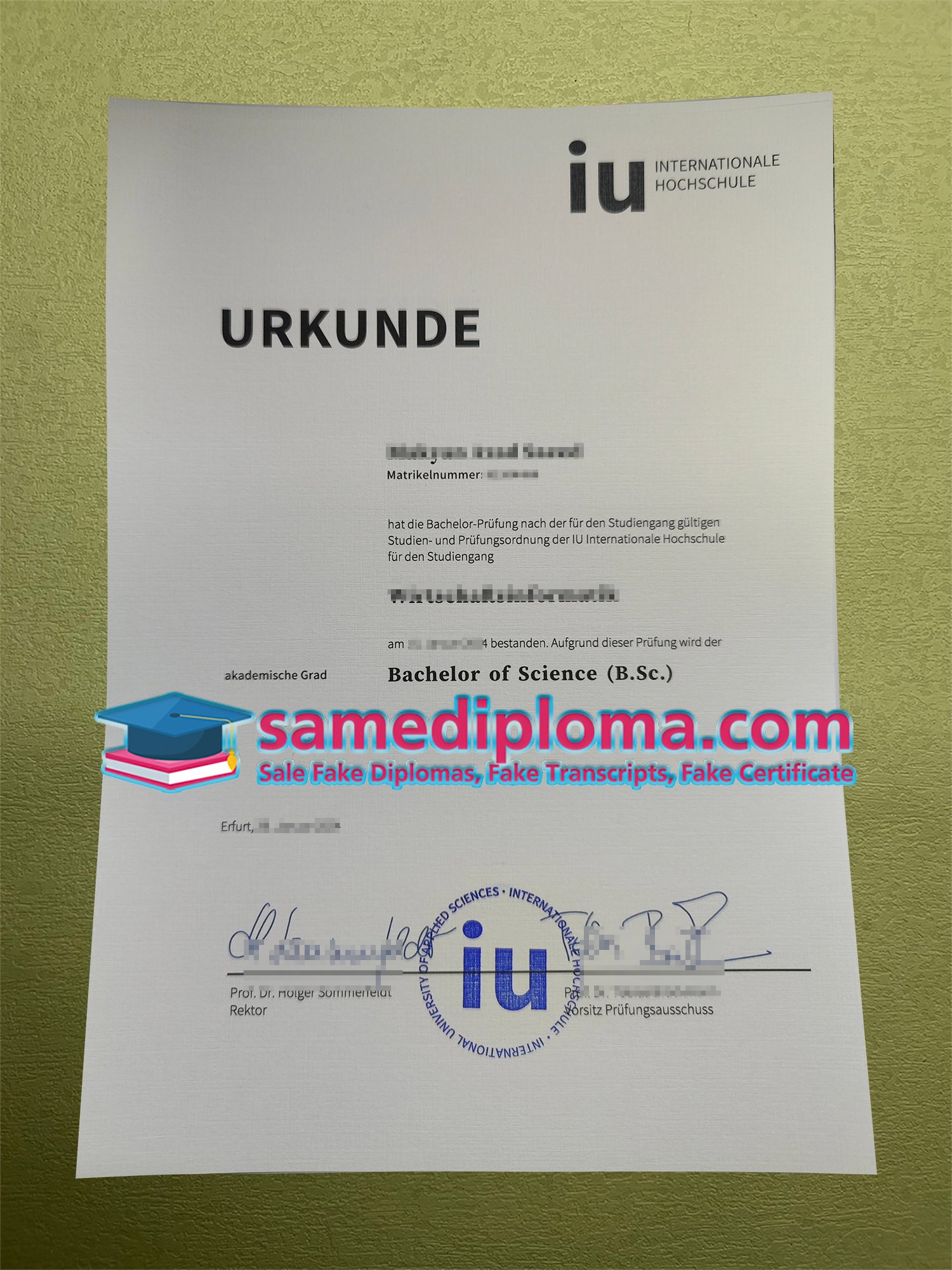
In German higher education, an Urkunde generally documents the award of an academic degree. A Zeugnis generally records examination or final results. A Transcript of Records usually provides a more detailed account of modules, grades, and credits.
These are broad distinctions rather than a description of every IU document version. Exact titles, contents, languages, and arrangements depend on the institution and applicable regulations. Confirm the requirements for your own programme instead of assuming that all documents follow one template.
For example, an employer may want confirmation of the qualification you earned. A university considering a further-study application may also need the subjects and credits you completed. The second request can require more information than a degree certificate provides.
If the instructions simply say “certificate,” ask for clarification. Explain which documents you have and request the exact name of the document they need. This is particularly useful when the correspondence switches between German and English.
Keep the recipient’s answer with the application instructions. It provides a clear reference when you contact IU or prepare your submission.
A Study Format Is Different from a Qualification
Your original reason for choosing IU may have involved flexibility, location, or the opportunity to combine study with work. Those details describe your learning experience. They do not, by themselves, identify the formal title of the qualification.
Distance learning, campus study, and dual study describe different approaches to learning. Likewise, a delivery language does not automatically establish the language of every graduation document. Check the particular programme and document guidance rather than filling gaps with assumptions.
IU’s current international campus FAQ identifies Erfurt as its headquarters. It distinguishes that location from its international teaching campuses. Therefore, a headquarters address should not become a claim that every graduate studied there.
For a personal description of your studies, use the experience that actually applies to you. Someone who studied remotely should not need a fictional campus story to make that achievement meaningful. Balancing study with work or family responsibilities can provide a much more personal account.
For formal records, however, follow the university’s wording. Personal storytelling belongs in a dedication or biography, rather than in a privately altered academic document.
Check the Programme Name Before Requesting Help
IU covers a broad range of subject areas, including business, technology, design, health, and social fields. That breadth makes precise programme names especially useful. A general phrase such as “business degree” may not identify the record you need.
Write down the programme title as it appears in your existing university information. Include the degree level and any relevant specialisation. If you are uncertain, describe the uncertainty rather than selecting a similar title from a current course catalogue.
Small differences can matter. For example, a management programme and a specialist MBA may concern related subjects while leading to different awards. Similarly, a health-related programme should not automatically become a medical qualification in an English description.
For translated material, keep the original title available alongside any explanation. An informal translation can help a reader understand the subject, but it does not replace an official document title.
This preparation also helps with a graduation gift. A short, accurate description of someone’s studies will usually feel more personal than a grander title that does not match their experience.
Online Help Works Better with a Specific Request
Before contacting the university, decide whether you need an initial document, a replacement, a correction, or guidance about sharing an existing record. Each enquiry asks for a different action. A clear opening sentence helps the office understand the issue.
Prepare your student identifier, programme information, and relevant dates. Then use the university’s established support channel for your study model. Avoid posting identity details or complete academic records in public comments.
A useful message might say: “I completed my programme in the stated period and need guidance on obtaining my graduation documents.” If you already have documents, explain what is missing or unclear.
Also mention any external deadline. Ask what the university can confirm and whether an alternative official document might meet the recipient’s needs. The receiving organisation must decide what it accepts.
Keep your enquiry reference and follow-up correspondence together. If the matter requires another message, continue the same thread where possible. That gives the staff member the context without requiring you to repeat the entire request.
How Long Should You Allow for the Documents?
IU’s international on-campus FAQ currently says that a degree certificate should arrive within up to ten weeks after the final grade. The starting point matters: this guidance refers to receiving the final grade, not simply submitting the final assignment.
Treat that statement within its published scope. It does not establish the turnaround for every study model, replacement request, translation, or correction. Ask the appropriate IU team about your particular circumstances.
If a deadline comes sooner, explain it to the recipient early. Ask which official evidence it can accept while you wait. Do not assume that a privately printed copy can satisfy a requirement for university-issued documentation.
A decorative keepsake follows a separate production schedule. Artwork approval, printing, and shipping do not affect the university’s academic processing. Any provider should explain its own confirmed timetable without presenting it as an official issuance service.
Keep a Graduation Display Personal and Clearly Labelled
A graduation display can tell the story of completing a demanding course without imitating an Urkunde. Consider an original illustration, a photograph, or a dedication that names the occasion. For a distance learner, a study-space photograph may carry more meaning than a generic campus image.
Choose wording that celebrates the experience accurately. A message about persistence or support from family can give the piece its character. There is no need to reproduce institutional signatures, seals, or verification features.
Make the non-official purpose visible on the artwork itself. A readable “Graduation keepsake — not an academic document” label should remain part of the finished composition.
For official use, return to the exact document requested and the university’s own guidance. For personal display, focus on what made the experience yours. Those two clear purposes make it easier to ask the right questions and avoid an unsuitable document.