What Does a Hochschule München Urkunde Represent?
When people search for Hochschule München Urkunde, other Germany Urkunde , they may be looking for information about the university, its graduation documents, or what an HM qualification represents. Hochschule München, also known internationally as HM Hochschule München University of Applied Sciences, is one of Bavaria’s major universities of applied sciences.
Founded in 1971, HM developed from the merger of several Munich-based engineering schools and higher technical colleges. Its academic tradition is therefore closely connected with engineering, technology and practice-oriented education. Over time, the university expanded into business, social sciences, design and other disciplines.
Hochschule München at a Glance
Hochschule München is based in Munich, one of Germany’s major centers for technology, business and industry. Today, the university has 14 faculties and two study faculties, covering areas ranging from architecture and engineering to computer science, business, social sciences, design and tourism.
The university currently lists around 100 degree programmes, including bachelor’s and master’s programmes as well as certificate-based continuing education. Its broad academic profile gives students the opportunity to combine specialized knowledge with practical applications.
This helps explain why the name Hochschule München appears in many different academic contexts. An Hochschule München Urkunde may relate to a particular degree or qualification rather than representing one standardized document for every student.
From Engineering School to a Broad University
The history of HM is strongly connected to technical education.
When the Munich University of Applied Sciences was established in 1971, it brought together seven predecessor institutions. The first academic structure included 23 subject areas, with engineering representing the largest part of the student population. The original programmes also included business, social services and design.
Practical education became an important part of this model from the beginning. In 1973, HM introduced practical semesters outside the university in cooperation with companies. This approach continues to influence the university’s educational profile today.
What Can Students Study at Hochschule München?
The range of subjects is much broader than engineering alone.
Current bachelor’s degree offerings include fields such as:
- Business Administration
- Computer Science
- Mechanical Engineering
- Electrical Engineering and Information Technology
- Automotive Engineering and Mobility
- Aerospace Engineering
- Civil Engineering
- Mechatronics
- Data Science and Scientific Computing
- Business Informatics
- Tourism Management
- Social Work
- Renewable Energy
- Architecture and Design
The university also offers master’s programmes and specialized courses in areas such as digital technology, engineering, business and communication.
This diversity is important when interpreting an Hochschule München Urkunde. The academic field, degree type and programme can all affect the information presented on an individual graduation document.
A Strong Focus on Practical Education
Hochschule München’s identity is closely connected with applied learning.
Students do not only study theoretical concepts. Depending on their programme, they may work on laboratory experiments, projects, practical assignments or industry-related activities. The university describes its educational approach as practice-oriented and future-focused.
This is particularly relevant in technical subjects. For example, the university’s engineering-related faculties cover mechanical engineering, electrical engineering, information technology, mechatronics, applied sciences and other technical disciplines.
At the same time, practical learning is not limited to engineering. Business, design, social sciences and other programmes also connect academic study with professional applications.
International Study at HM
Hochschule München also has an international dimension.
The university welcomes international degree-seeking students, although most of its programmes are taught in German. Some programmes and courses are available in English, particularly in selected technical and scientific areas.
For international students, this creates an interesting combination: studying at a German university of applied sciences while gaining knowledge that can be relevant to both the German and international employment markets.
Understanding a Hochschule München Urkunde
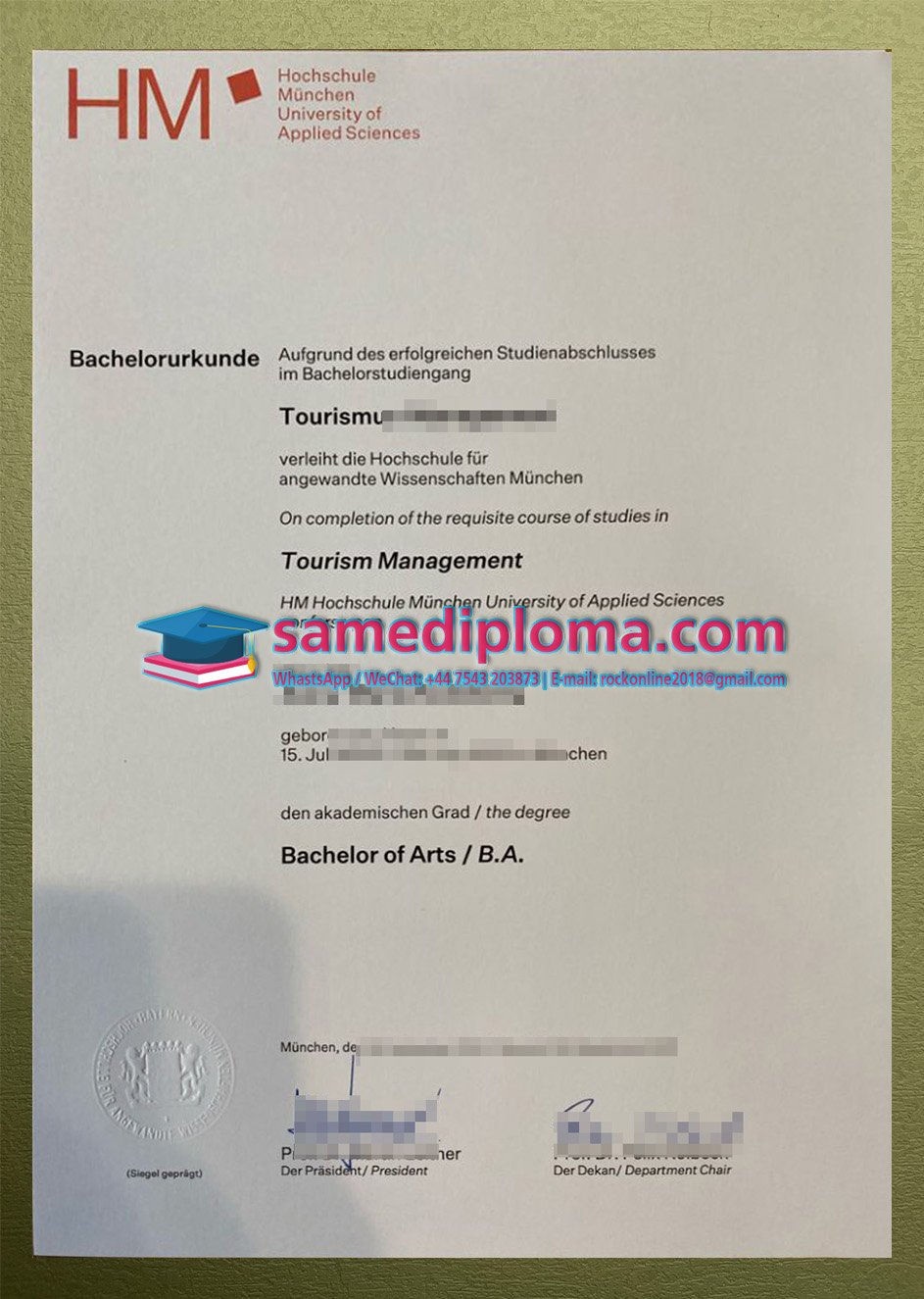
The German word Urkunde generally refers to an official document or certificate. In a university context, it can refer to a formal document associated with an academic qualification.
However, an Hochschule München Urkunde should not be viewed in isolation.
A graduate may have several documents connected with their studies, depending on the qualification and programme. These can include a degree certificate or Urkunde, a transcript or record of academic results, and other supporting documents.
The exact terminology and format can also vary according to the type of qualification and the period in which it was issued. Older documents may therefore look different from documents issued under newer academic structures.
Urkunde, Diploma and Transcript: What’s the Difference?
These terms are sometimes used interchangeably in English-language discussions, but they do not necessarily describe the same document.
Urkunde generally refers to the formal certificate confirming an academic qualification.
A transcript provides detailed information about courses, examinations, grades or credits.
The word Diplom has a specific historical meaning in German higher education. Hochschule München’s history shows that some traditional diploma programmes were later converted into bachelor’s and master’s structures. For example, its Department of Applied Sciences and Mechatronics records the conversion of several diploma programmes to bachelor’s programmes in 2007.
Therefore, when researching an older Hochschule München Urkunde, it is useful to consider both the programme and the date of issue.
Final Thoughts
An Hochschule München Urkunde is best understood within the broader context of HM’s applied higher education system. Founded in 1971, Hochschule München has grown from a group of technical predecessor institutions into a large university of applied sciences covering engineering, computer science, business, design, social sciences and other fields.
For anyone researching an HM academic document, the most useful details are usually the degree type, programme, date of issue and accompanying academic records. These details provide much more context than the word “Urkunde” alone.
Note: If an image of an actual Hochschule München Urkunde is published online, personal information such as the graduate’s name, address, student number, date of birth or signatures should be redacted before publication.